
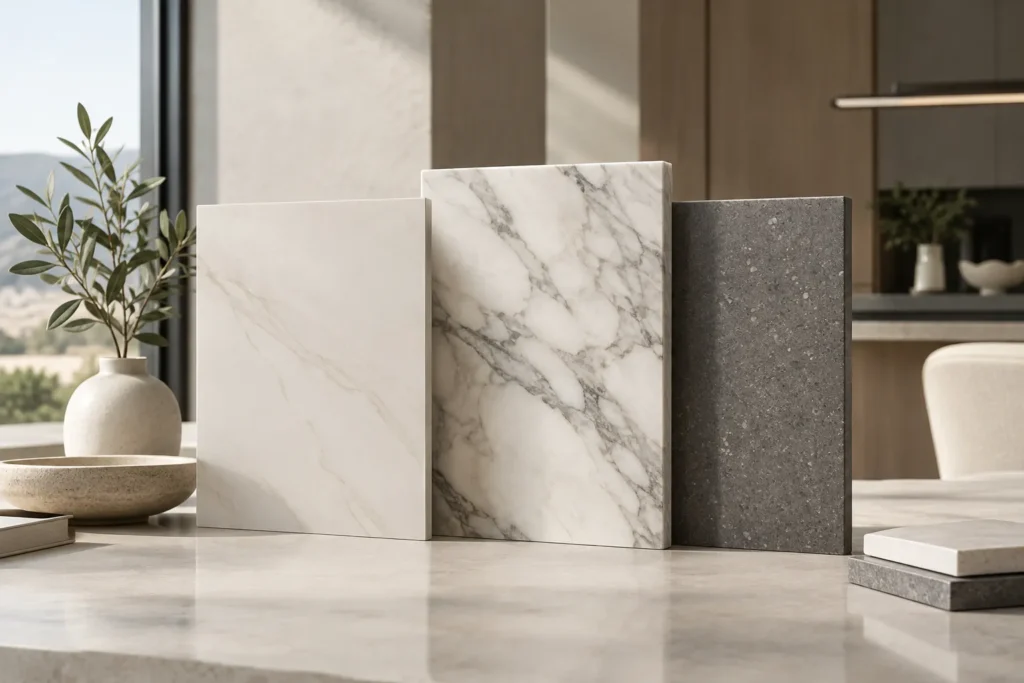
Choosing between porcelain vs marble is rarely a search for the “better” material. It is a search for the material that behaves best in a particular room, under the daily habits of the people who use it. Add engineered stone to the comparison, and the decision becomes more interesting, because each of the three solves a different problem.
This guide compares them in practical terms: appearance, durability, water and stain resistance, maintenance, and cost. It is written for homeowners, villa and apartment owners, and businesses in Egypt who are planning a renovation or fit-out and need to choose interior finishing materials with confidence. By the end, you should know which material suits each area of your project and what to ask before approving a sample.
Which Material Should You Choose?
The right answer depends on what you want the surface to do. The sections that follow explain the reasoning in detail.
When marble is the best choice
Marble is the right choice when natural character is the point of the space. Every slab has its own veining and tone, so a marble floor or feature wall cannot be exactly copied. It suits formal living rooms, entrance halls, master bathrooms and reception areas, provided the owner accepts that it will age and needs consistent care.
When porcelain makes more sense
Porcelain makes more sense when a surface has to work hard with little fuss. Family homes, kitchens, terraces, offices, and commercial areas benefit from a dense body that handles moisture and daily wear. Modern porcelain tile can also imitate stone convincingly, which gives you a marble-inspired look without the habits marble demands.
When engineered stone is the better option
Engineered stone is the better option when you want a uniform, predictable surface on worktops, vanity tops and similar areas. It is non-porous, easy to clean and consistent from one slab to the next, which helps when a design depends on a clean, controlled pattern.
Understanding the Three Materials
Interior finishing materials sit exactly where design intent meets site execution, which is why choices about them go more smoothly when interior design and fit out are planned as one connected process rather than two separate ones.
What is natural marble?
Natural marble is a metamorphic stone formed from limestone and made up mainly of calcium carbonate. It is quarried in blocks, cut into slabs or tiles, then finished honed or polished. Because it is natural stone, colour and veining differ from block to block, and two deliveries of the “same” marble can look noticeably different.
Egypt also has its own stone sector. Government sources describe the Shaq El-Thoban area in Cairo as one of the most important centres of the marble and granite industry in Egypt, so it is worth asking suppliers whether a local option exists before assuming imported stone.
What is porcelain tile?
Porcelain tile is a dense ceramic tile made from refined clays and fired at high temperature. Standards define it by low absorption: according to the Tile Council of North America, a tile counts as porcelain when its water absorption is 0.5% or less. The same source notes that some tile sold as porcelain does not meet that standard, so ask for the technical data sheet rather than relying on a label.
What is engineered stone?
Engineered stone is a manufactured slab, usually made by binding crushed quartz with resins and pigments. It is often sold as “quartz,” which is not the same as quartzite, a natural stone. The process gives it a consistent pattern and a non-porous surface, and it is most often used for kitchen worktops, vanity tops and similar surfaces.
Porcelain vs. Marble vs. Engineered Stone: Key Differences
- Appearance
Marble offers natural veining that cannot be repeated. Porcelain tile texture covers the widest range of the three: polished, matte, honed and structured finishes, with designs that imitate stone, concrete or wood. Engineered stone gives the most even look, with controlled patterns that some designers prefer for clean, modern spaces and others find less natural at large scale.
Large-format porcelain and engineered slabs also mean fewer joints than standard tiles, which changes how a floor or wall reads.
- Durability
Marble is a relatively soft stone. It can scratch and, as explained below, it reacts to acids. Porcelain is hard and holds up well to wear, although edges can chip and a heavy point impact can crack a tile.
Engineered stone is durable in daily use, but its resin binder can be sensitive to high heat, so hot pans need trivets. Check the manufacturer’s guidance for each product, including which cleaning products it recommends.
- Water and stain resistance
Porcelain’s low absorption makes it the most water resistant of the three. Engineered stone is non-porous, so liquids stay on the surface. Marble is porous and can absorb liquids, which is why it is normally sealed.
Sealing helps against stains, but it does not prevent etching, the dull marks left when acidic substances such as lemon juice, vinegar or some cleaning products touch the surface.
- Maintenance
Porcelain and engineered stone need routine cleaning with mild products. Marble needs pH-neutral cleaners, quick attention to spills and periodic resealing. Polished marble that has dulled can usually be honed and repolished by a specialist.
- Cost
Cost varies by grade, origin, thickness, finish and fabrication, so no material is automatically the cheap or the expensive one. Marble ranges widely by variety and rarity. Porcelain runs from basic tiles to premium large-format slabs. Engineered stone depends on brand and thickness. The cost section below explains why the price of the material alone rarely tells the full story.
Marble: Best for Natural Character and Luxury
Advantages
- Natural veining and depth that manufactured surfaces only imitate
- A wide range of tones and finishes, including polished and honed
- A timeless look that suits both classic and contemporary interiors
- Can be restored by honing and repolishing rather than replaced
Limitations
- Etches when acidic substances touch the surface, even if sealed
- Porous, so it needs sealing and prompt spill cleaning
- Varies between batches, so approve actual slabs and not only a small sample
- Heavy, and harder to cut and handle than tile
Best applications
Marble works best in formal living rooms, entrance halls, feature walls, master bathrooms and other areas where spills are rare and the surface is meant to be admired. In kitchens it can work with a honed finish and realistic expectations, since honing makes light etching less visible.
Decisions about where marble goes, how slabs are laid out and how lighting will fall across the surface belong in the design stage. StroV’s Design House service line covers design, documentation and concept development, which is where those choices are worked through before anything is ordered.
Porcelain: Best for Durability and Low Maintenance
Advantages
- Very low water absorption, suited to wet areas and busy floors
- A wide design range, from stone and concrete looks to plain matte finishes
- Hard-wearing, with simple day-to-day cleaning
- Available in large formats that reduce grout lines
- More consistent between batches than natural stone
Limitations
- Printed designs can show a different colour at a chipped edge
- Large slabs need skilled handling and cutting
- Installation depends on a flat, properly prepared substrate
- Up close, it has less natural depth than real marble
Best applications
Porcelain suits floors throughout the home, kitchens, bathrooms, balconies, terraces, offices and commercial spaces. It is also widely used for wall cladding, and some slab formats are used for worktops and wall panels. When the goal is a stone look with lower upkeep, a well-chosen porcelain tile texture is often the most practical route.
Engineered Stone: Best for Consistency and Performance
Advantages
- Uniform pattern and colour from slab to slab
- Non-porous surface that resists staining and is simple to clean
- Low daily maintenance
- Well suited to worktops, vanity tops and splashbacks
Limitations
- Fabrication dust needs proper controls, as explained below
- Generally not chosen for direct sunlight outdoors
- Long runs may show seams that need careful planning
- Less common as flooring than porcelain or marble
One point deserves attention before you order. Some engineered stone products contain very high levels of crystalline silica, and the US National Institute for Occupational Safety and Health treats dust control during cutting and finishing as critically important for these products. Ask your fabricator how slabs are cut, for example whether wet cutting and dust extraction are used, and have cutting done in a workshop where practical.
Best applications
Engineered stone is at its best on kitchen worktops, vanity tops, splashbacks, reception desks and commercial counters, where consistency and easy cleaning matter more than natural variation.
Which Material Works Best for Each Area of Your Home?
Living rooms
Living rooms are where the material is most visible. Marble gives an unmatched sense of depth on floors and feature walls, while porcelain with a stone-look finish is a sensible choice for large open areas with heavy traffic.
Kitchens
For kitchen worktops, engineered stone and porcelain slabs are the lower-maintenance options. Marble can be used if you accept that it will etch over time. For kitchen floors, porcelain is usually the easiest to live with.
Bathrooms
Porcelain is a strong choice for bathroom floors and wet zones, and it is worth checking the slip resistance information for any floor tile. Marble can work on walls and vanities where care is realistic. Engineered stone is common for vanity tops.
Flooring
In the marble vs porcelain flooring decision, marble flooring gives natural character but needs sealing, occasional polishing and care around acids and water. Polished marble can also feel slippery when wet. Porcelain offers a wider range of finishes with far less upkeep. Engineered stone is used more for worktops than for floors.
Walls and feature surfaces
Marble is a natural choice for a single dramatic feature wall. Porcelain slabs suit cladding and wet walls where fewer joints and easy cleaning are useful. Engineered stone works well as a splashback or reception backdrop where a uniform finish is wanted.
How Cost and Maintenance Affect Your Material Choice
Initial material cost
The price per square metre is only the starting point. Thickness, finish, edge details, wastage and the number of cuts all change the final figure. When you compare quotations, understanding how a BOQ compares with cost-plus pricing helps you see what each figure actually includes.
Installation considerations
Each material asks something different of the installer. Marble needs experienced fixing and often sealing or polishing after installation. Large-format porcelain needs a flat substrate, the right adhesive and careful cutting. Engineered stone is usually templated and fabricated to size before it arrives.
Execution work of this kind falls under Fine Finishes, StroV’s fit-out and contracting service line, so installation quality can be planned alongside material selection.
Long-term maintenance
Over the years, marble asks for resealing and occasional polishing. Porcelain mostly needs cleaning and grout upkeep. Engineered stone needs very little beyond routine cleaning and heat protection. A material that costs less to buy can cost more to keep, so consider both.
Replacement and durability
Marble can often be restored rather than replaced. Porcelain rarely needs replacing, but a damaged tile can be difficult to match if the batch has been discontinued, so keep a few spare boxes from the same batch. With engineered stone, a serious chip or crack in a worktop may mean replacing the affected piece.
How to Choose the Right Interior Finishing Materials for Your Project
Consider the function of the space
Start with what the room has to do. A guest reception, a family kitchen and a rental unit all place different demands on a surface. Match the material to the most demanding use in the space, not the average one.
Consider daily usage
Think about how the surface will really be used. These questions help:
- Will the surface see heavy foot traffic, water or frequent washing?
- Will people cook, spill or place hot items on it?
- Is the area exposed to direct sunlight?
- How much care are you willing to give it each month?
Balance aesthetics and practicality
You do not have to choose one material for the whole project. Many well-resolved interiors use marble where it is admired, porcelain where performance matters and engineered stone where surfaces are worked hardest.
Align materials with the overall design concept
Materials should support the design idea, not compete with it. Understanding the interior design process shows how material selection fits between concept development and execution, so samples are approved before purchasing begins.
Choosing Materials With StroV
The best material decisions are made with drawings, samples, and site conditions in front of you. StroV is a Cairo-based interior design and fit-out practice with two service lines: Design House for design and documentation and Fine Finishes for fit-out and execution.
If you are comparing materials for a villa, apartment, or commercial space, you can contact StroV to discuss your requirements and how the choices fit your project.